
Fuse Holders
How to Choose the Right Fuse Holder for Reliable Equipment Protection
24th August 2026
By Team Elcom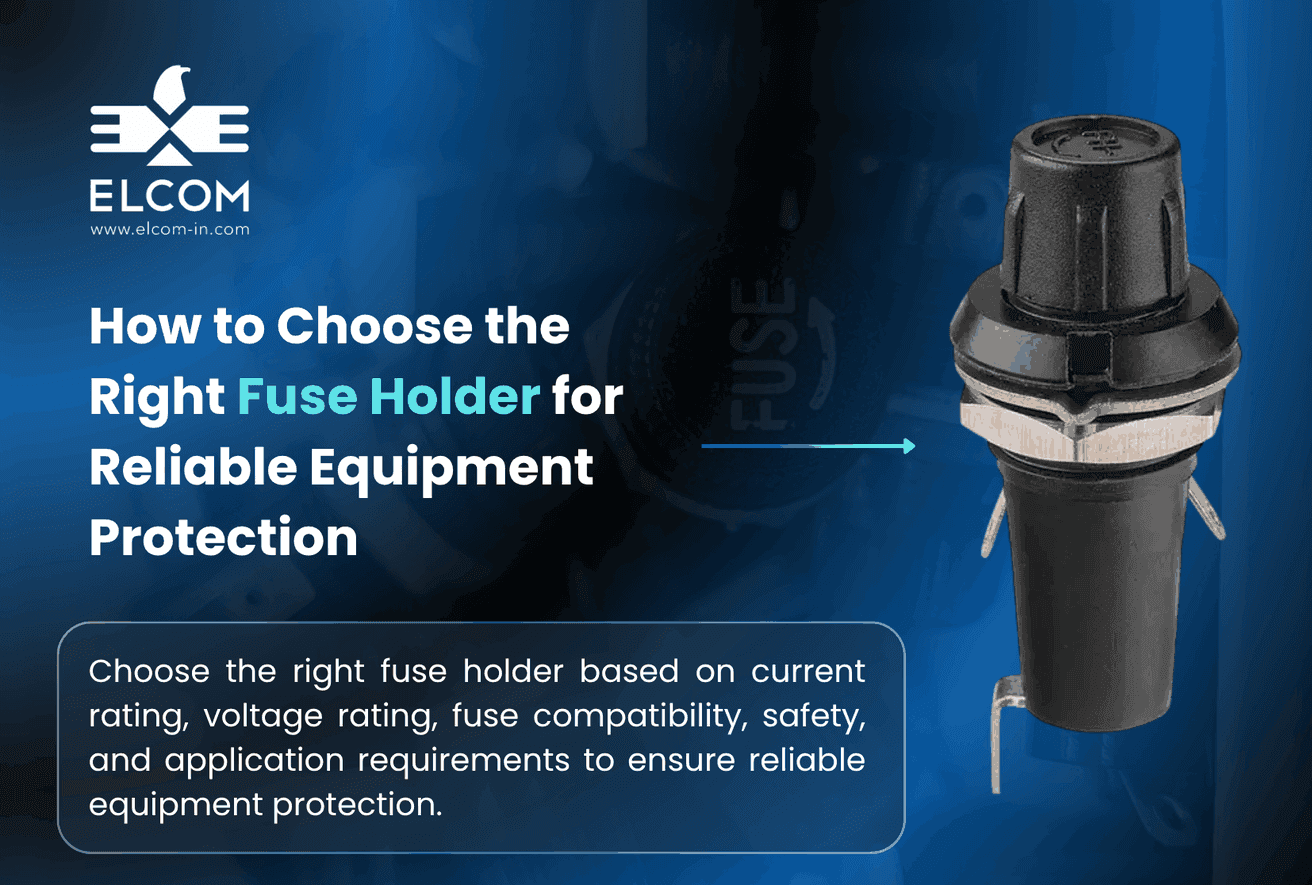
The right fuse holder does more than secure a fuse. It helps protect equipment from electrical faults and ensures dependable performance. This guide explains the key factors to consider when choosing the right option for your application.
A fuse only protects a circuit if it’s held securely, wired with low-resistance contact, and easy to replace without exposing anyone to live parts. That’s the job of the fuse holder, and it’s a job that’s easy to underrate, since the actual interruption of an overcurrent event is performed by the fuse link, not the holder itself. Choosing the wrong fuse holder doesn’t necessarily stop a fuse from working, but it can undermine the reliability of the whole protection scheme through poor contact, incompatible fuse sizing, or a mounting choice that doesn’t suit the equipment.
This guide walks through what a fuse holder actually does, the main types available, and the specific factors worth checking before specifying one for reliable equipment protection.
What Does a Fuse Holder Do?
It’s worth being precise about the division of labour here. The fuse link, the replaceable fuse itself, is what interrupts the circuit when current exceeds its rating. The fuse holder’s role is to keep that fuse securely in place, maintain a stable, low-resistance electrical connection to the circuit, insulate the surrounding area from live parts, and allow the fuse to be swapped out quickly once it’s done its job.
Fuse holders for miniature cartridge fuses are covered by IEC 60127-6, which sets uniform requirements for the electrical, mechanical, thermal, and climatic properties of fuse holders and defines compatibility between holders and fuse links. This standard applies to holders rated up to 16A and up to 1,000V AC or 1,500V DC, for indoor use, which covers the great majority of fuse holders used in industrial and electronic equipment.
Types of Fuse Holders and Where They’re Used

Fuse holders come in a handful of mounting styles, each suited to a different point in the equipment:
- Panel mountable:
Fitted through a cut-out in an enclosure panel, accessible from outside for straightforward fuse replacement without opening the unit
- Chassis mountable:
Secured directly to an internal chassis, typically with screw-type mounting, used where the fuse doesn’t need to be externally accessible
- PCB mountable:
Soldered directly onto a circuit board, protecting a specific board-level circuit
- Snap mounting:
Clips into a panel cut-out without separate fasteners, useful where assembly speed matters
- Hanging or in-line:
Wired directly into a cable run rather than mounted to a panel or chassis
The right type depends on where in the equipment the fuse needs to sit and how often it needs to be accessed, not on which style happens to be cheapest or most familiar.
Key Factors to Consider When Choosing a Fuse Holder
- Current and voltage rating.
The holder’s rated current and voltage need to meet or exceed those of the fuse it will carry, not just the circuit’s nominal operating current. A holder rated below the fuse it’s paired with becomes the weak point in the circuit, regardless of how well the fuse itself is specified.
- Fuse link size and type compatibility.
Miniature fuses commonly come in standard sizes such as 5x20mm and 6.3x32mm, and a holder built for one size won’t accept the other. Confirm the fuse link dimensions your circuit calls for before selecting the holder, since this is a physical constraint, not just a rating on a datasheet.
- Contact resistance and terminal material.
Terminals are typically brass with tin plating, chosen for stable, low contact resistance over repeated fuse changes. Lower contact resistance reduces the heat generated at the connection point; it’s worth being clear that the holder isn’t dissipating heat the way a heat sink would; it’s simply generating less of it in the first place through good contact and material choice.
- Mounting style and panel thickness.
Panel mountable holders are rated for a maximum panel thickness (commonly 3mm to 5mm depending on the model), and exceeding that figure can prevent the mounting mechanism from seating correctly.
- Operating temperature range.
Most fuse holders for general industrial and electronic use are rated for a wide ambient range, commonly -20°C to +85°C, but you should check this against the equipment’s actual internal operating conditions, especially if the holder sits near other heat-generating components.
- Insulation resistance and dielectric withstand.
Look for insulation resistance figures (commonly rated in hundreds of megaohms at 500V DC) and a high-voltage breakdown withstand test result, both of which relate directly to shock protection and long-term insulation integrity.
- Finger-safe construction.
Many fuse holders are designed so the fuse can be removed and replaced without exposing a finger to a live contact, an important safety feature in equipment where the fuse holder is accessible during routine maintenance.
- Standards compliance.
Beyond IEC 60127-6, check for CE marking and RoHS compliance where relevant, since these confirm the specific safety and environmental testing appropriate to the target market.
Common Mistakes That Undermine Equipment Protection
The most frequent error is sizing the holder to the circuit’s everyday current rather than to the fuse it’s actually going to carry, which leaves no margin if a higher-rated fuse is fitted later. A close second is assuming any 5x20mm-style holder will do without checking the exact fuse link dimensions, which leads to a fuse that either won’t seat properly or sits with poor contact pressure. It’s also worth not treating the fuse holder as a thermal management component in its own right; its job is to minimise the heat generated at the connection, not to remove heat that’s already built up elsewhere in the circuit.
Getting Equipment Protection Right Starts with the Fuse Holder

Choosing the right fuse holder comes down to matching current and voltage rating to the fuse it will carry, confirming the physical fuse link size, and picking a mounting style and temperature rating suited to where it sits in the equipment. Get that match right, and the fuse holder does its actual job well: keeping the fuse secure, in good contact, and safe to replace, for as long as the equipment is in service.
Elcom International manufactures fuse holders across panel-mountable, chassis-mountable, PCB-mountable, snap-mounting, and hanging configurations, with rated current from 6.3A to 30A and an operating temperature range of -20°C to +85°C across the range. Our models, including the FH-1, FH-6, and FH-7 series, are built to IEC 60127-6 with CE and RoHS compliance available, using brass terminals with tin plating and nylon bodies, and are compatible with standard 5x20mm and 6.3x32mm fuse link sizes depending on the model. As one of the established fuse holder manufacturers supplying power supplies, UPS systems, solar and water purification equipment, and medical devices, we test our fuse holders in-house before they ship.
If you’re specifying fuse holders for a new product or an existing design that needs a reliable replacement, we can help you match current rating, fuse link size, and mounting style to your equipment.
Get in touch with our team to find the right fuse holder for your application.

Looking for help?
Our team is ready to assist you and provide the support you need