
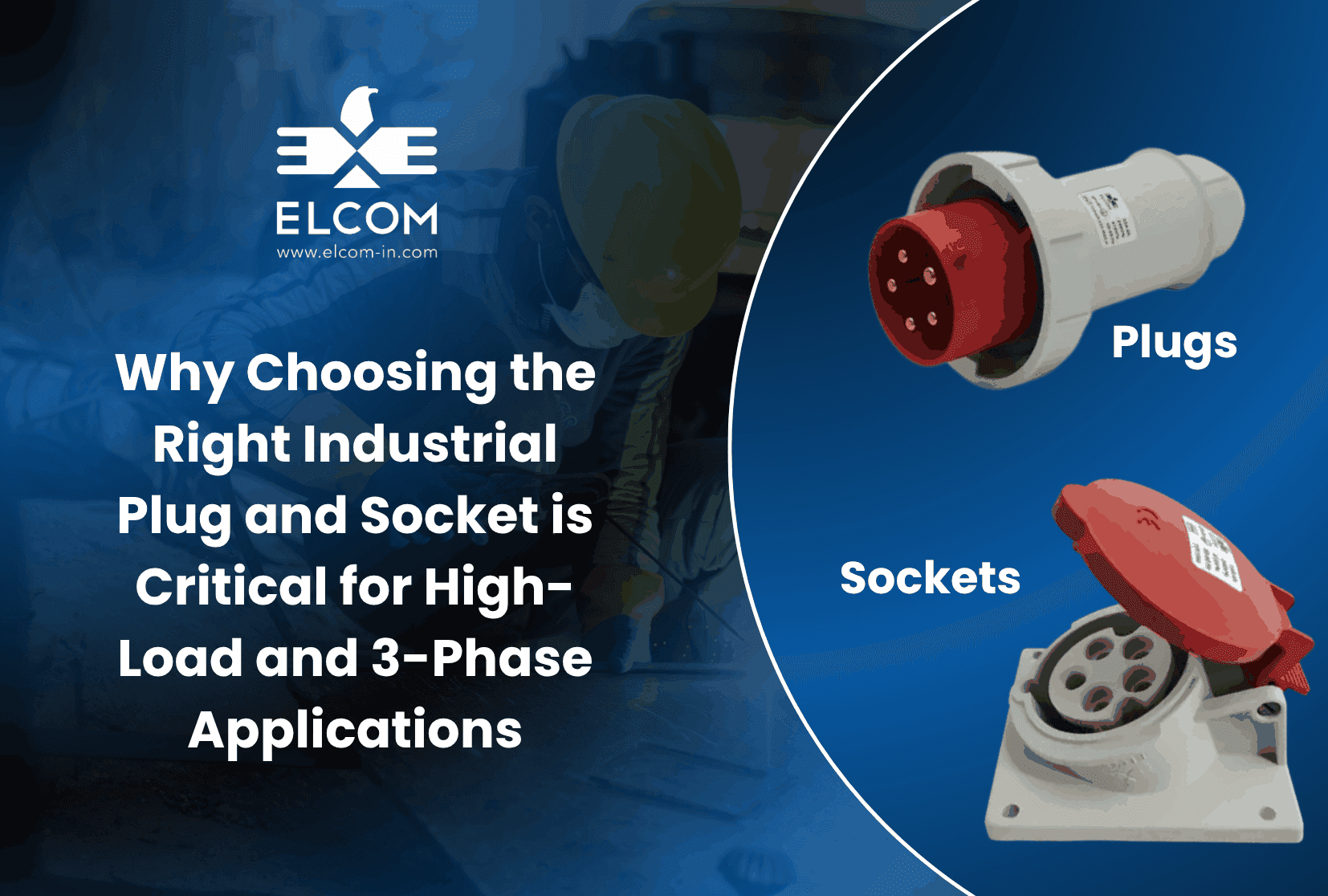
Why Choosing the Right Industrial Plug and Socket Is Critical for High-Load and 3-Phase Applications
Industrial plugs and sockets play a vital role in powering high-load and 3-phase systems safely and efficiently. This guide highlights the key considerations for choosing the right solution for demanding industrial applications.
A domestic socket and an industrial one look like they solve the same problem, but they don’t operate under the same conditions. Industrial equipment draws far more current, often across three phases instead of one, and runs in environments with dust, moisture, vibration, and continuous duty cycles that a household outlet was never built for. Choosing the right industrial plug and socket for that environment isn’t a matter of preference; it’s what determines whether the connection stays safe and reliable under real load, or becomes the weak point in the system.
This guide breaks down what separates industrial plugs and sockets from standard ones, how pin configuration and current rating work for 3-phase systems, and the specific factors worth checking before specifying industrial electrical sockets for a high-load application.
What Makes an Industrial Plug and Socket Different from a Standard Outlet?
Industrial plugs and sockets are built to IEC 60309, the international standard covering plugs, socket-outlets, and couplers for industrial use. Unlike a household plug, an industrial plug socket uses a round, keyed pin arrangement that physically prevents a plug rated for one voltage or current class from being inserted into a socket built for another. The housing is typically moulded from polyamide for impact and heat resistance, with brass contacts for conductivity, and the whole assembly is colour-coded by voltage range so the correct connection is identifiable at a glance, commonly blue for the 200 to 250V single-phase range and red for the 380 to 480V three-phase range.
This construction is what allows an industrial plug and socket to be rated for current levels and duty cycles that a domestic fitting was never designed to handle.
Understanding Pin Configurations for Single-Phase and 3-Phase Systems
Pin configuration tells you what kind of circuit a connector is built for, and it’s marked directly on the body:
- 2P+E: Two poles plus earth, used for single-phase circuits
- 3P+E: Three phases plus earth, used for three-phase circuits without a neutral conductor
- 3P+N+E: Three phases, neutral, and earth, used where the load needs a neutral return
A 3-phase industrial socket is nearly always built around one of the latter two configurations, and getting this detail right matters as much as getting the current rating right. Plugging equipment into the wrong phase configuration doesn’t just fail to work; it can create unbalanced loads that stress conductors and connected equipment.
Current ratings for industrial connectors follow standard steps: 16A, 32A, 63A, and 125A are the most common. Each step up is a genuine jump in what the connector and its terminals are built to carry, not just a bigger number on the label.
Why High-Load and 3-Phase Applications Raise the Stakes
At low current, a slightly undersized or poorly seated connection might just run a little warm. At the current levels involved in 3-phase industrial supply, the same poor connection generates more heat meaningfully at the contact point, since heat generated at a connection rises with the square of the current passing through it. That heat degrades the contact surface further, which increases resistance, which generates more heat still. It’s a cycle that a correctly rated and properly installed industrial plug and socket is designed to prevent, provided the connector is matched to the actual load and installed with the correct terminal torque and cable size.
The consequences of getting it wrong scale with the load too. A failed connection on a 16A circuit is an inconvenience. A failed connection feeding a 63A or 125A three-phase machine is a safety incident and, usually, unplanned downtime on equipment that’s expensive to have sitting idle.
Key Factors to Consider When Selecting Industrial Electrical Sockets

- Current and voltage rating: Match the socket’s rating to the equipment’s actual load, with margin, and confirm the voltage range matches the supply, not just the connector’s colour coding.
- Pin configuration and phase type: Confirm whether the application needs 2P+E, 3P+E, or 3P+N+E before ordering; a 3-phase industrial socket without the neutral your equipment needs won’t work regardless of its current rating.
- IP rating for the environment: IP44 provides splash protection suited to dry or lightly exposed indoor installations. IP67 provides dust-tight, temporary-immersion protection suited to outdoor, washdown, or heavily exposed environments. The correct rating depends on where the socket is actually installed, not on a general assumption about “industrial” environments.
- Contact material and housing construction: Brass contacts support lower contact resistance over repeated matings, and a polyamide housing with a high glow-wire resistance rating supports better fire safety under fault conditions, though actual performance still depends on installation quality and maintenance.
- Cable size and terminal compatibility: Higher current classes require correspondingly larger cable cross-sections and terminal capacity; a 63A socket with an undersized cable doesn’t gain the socket’s full rating; it inherits the cable’s limitation instead.
- Standards compliance: IEC 60309-1 and IEC 60309-2 cover general and dimensional requirements, respectively, with CE, UL, and RoHS approvals confirming the specific safety and environmental testing relevant to the target market.
Matching Current Rating to the Application
As a general pattern, 16A sockets typically serve light industrial tools and lighting circuits, 32A covers medium machinery and sub-distribution, 63A handles heavier equipment feeds and generator connections, and 125A is used for main incoming supply. These are starting points, not fixed rules; the correct rating for any specific installation is set by the connected equipment’s actual current draw and duty cycle, not by the general category the equipment falls into.
Getting the Connection Right Starts with Matching the Socket to the Load
Choosing an industrial plug and socket for a high-load or 3-phase application comes down to matching current rating, phase configuration, IP protection, and cable capacity to the equipment and environment it’s serving, rather than assuming any connector marked “industrial” will do. Get that match right, and the connection point stops being a risk and becomes just another reliable part of the system.
